6 bills
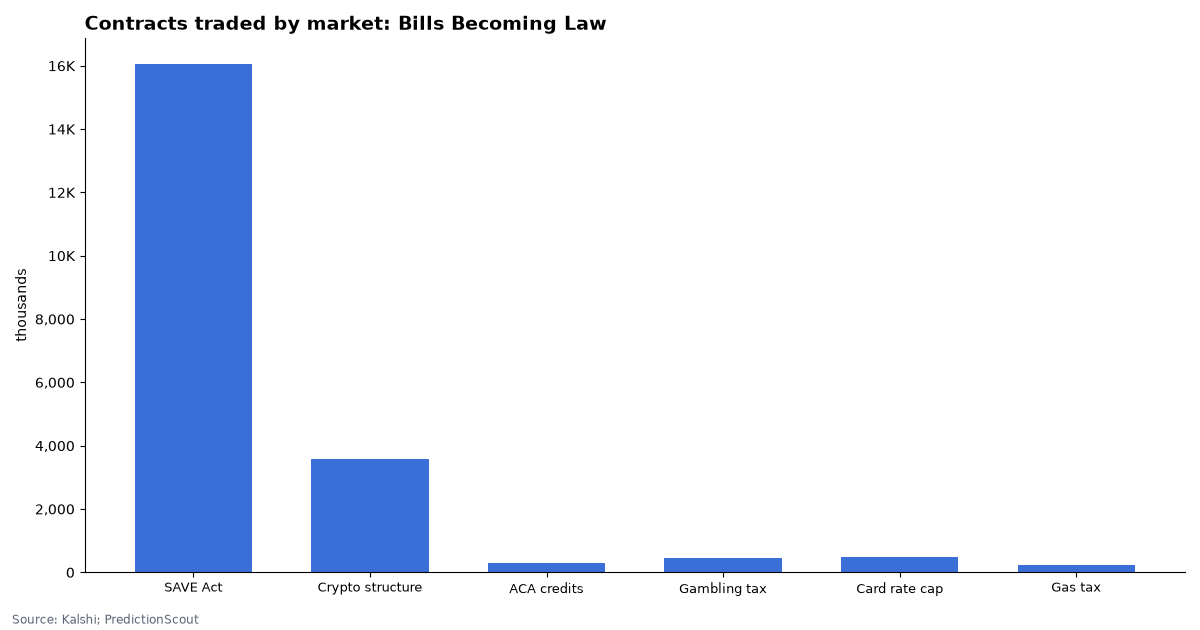
Kalshi lists 6 live markets on whether a bill becomes law. The most traded, the SAVE Act (H.R. 22), has 16,071,700 contracts traded and is priced at 1% to be enacted before Jan. 4, 2027, when the 119th Congress ends.
Kalshi market data and Congress.gov (Library of Congress), pulled Nov 12, 2026, 8:05 AM ET. Updated daily.
By Arthur Angelo, PredictionScout Research · Updated Nov 12, 2026, 8:05 AM ET
Key findings
- SAVE Act (H.R. 22) becomes law: Before Jan 4, 2027: 1%.
- A crypto market-structure bill becomes law: Before Jul 1, 2027: 12% · Before Oct 1, 2027: 15% · Before Jan 1, 2028: 24%.
- Enhanced ACA premium tax credits extended or reinstated: Before 2028: 30% · Before 2027: 2%.
- Change to the 2025 law’s gambling-loss tax provision: Before Sep 1, 2027: 43% · Before Jan 1, 2028: 49% · Before Jan 1, 2029: 55%.
- Federal cap on credit-card interest rates: Before 2028: 16% · Before 2027: 2%.
The markets and where each bill stands
Each market pays $1 if the legislation becomes law by the date shown. The right-hand column is the latest official action on the matching bill from Congress.gov; for markets that do not name a bill, we show the most relevant pending bill and note that any qualifying law would count.
| Market | Chance by deadline | Matching bill: latest action | Contracts traded |
|---|---|---|---|
| SAVE Act (H.R. 22) becomes law | Before Jan 4, 2027: 1% | H.R. 22 (SAVE Act): Received in the Senate. (2025-04-10); 110 cosponsors | 16,071,700 |
| A crypto market-structure bill becomes law | Before Dec 1, 2026: 0% · Before Jan 1, 2027: 3% · Before Apr 1, 2027: 10% · Before Jul 1, 2027: 12% · Before Oct 1, 2027: 15% · Before Jan 1, 2028: 24% | H.R. 3633 (Digital Asset Market Clarity Act): Motion by Senator Tillis to reconsider the vote by which cloture on the motion to proceed to the measure was not invoked (Record Vote No. 234) entered in Senate. (2026-09-15); 21 cosponsors | 3,588,812 |
| Enhanced ACA premium tax credits extended or reinstated | Before 2028: 30% · Before 2027: 2% | H.R. 247 (Health Care Affordability Act of 2025): Referred to the House Committee on Ways and Means. (2025-01-09); 165 cosponsors | 295,193 |
| Change to the 2025 law’s gambling-loss tax provision | Before Jan 1, 2027: 5% · Before Apr 1, 2027: 26% · Before Sep 1, 2027: 43% · Before Jan 1, 2028: 49% · Before Jan 1, 2029: 55% | S. 2230 (Facilitating Useful Loss Limitations to Help Our Unique Service Econom): Read twice and referred to the Committee on Finance. (2025-07-09); 8 cosponsors | 444,152 |
| Federal cap on credit-card interest rates | Before 2028: 16% · Before 2027: 2% | S. 381 (10 Percent Credit Card Interest Rate Cap Act): Read twice and referred to the Committee on Banking, Housing, and Urban Affairs. (2025-02-04); 3 cosponsors | 480,328 |
| Federal gas tax suspended or cut | Before Jan 1, 2027: 2% | No specific bill is named in the contract; any enacted law counts | 226,366 |
Market middle: for “above X” ladders, the point where the implied chance crosses 50% (prices forced to fall as the threshold rises, interpolated between rungs). Prices are the bid/ask midpoint when the spread is 10¢ or less, otherwise the last trade. Events with fewer than 500 contracts traded show “thin trading” instead of a middle, and ladders whose quoted prices contradict each other show “prices out of order”. Pulled Nov 12, 2026, 8:05 AM ET.
How “becomes law” is settled
A bill becomes law when the President signs it, when ten days pass (Sundays excepted) without a signature while Congress is in session, or when both chambers override a veto by two-thirds. Passing one chamber does not count. The contract checks the enactment date, which Congress.gov records as “Became Public Law No.” in the bill’s actions. Markets that describe a kind of legislation (a credit-card cap, a gas-tax holiday) resolve Yes if any law with that effect is enacted, including a provision tucked into a larger bill.
Every bill dies when a Congress ends. The 119th Congress ends on Jan. 3, 2027; a bill not enacted by then must be reintroduced with a new number, which is why several deadlines sit at or just after that date.
What moves the numbers
The steps a bill still has to clear: committee markup, a floor vote in each chamber, a Senate cloture vote (60 votes for most bills), reconciling House and Senate versions, and signature. Prices move when a step is scheduled or fails, when leadership attaches a bill to must-pass legislation such as a spending bill, and on election results that change who controls each chamber.
Base rate
Most bills never become law. In recent Congresses roughly 2–4% of introduced bills were enacted, and many of those were narrow measures such as post-office namings. A bill that has already passed one chamber does better, but still often stalls in the other.
Worked example
The SAVE Act passed the House and was “Received in the Senate” on April 10, 2025. To become law before Jan. 4, 2027 it would need a Senate vote (and, absent a rule change, 60 votes to end debate), then the President’s signature. A price of 4% means a $1 Yes contract costs about 4 cents; it pays $1 only if Congress.gov records it as a public law before the deadline. If the Senate passes an amended version, it must go back to the House before it can be signed.
Download the data
Bills Becoming Law markets (one row per event) (CSV)
One row per live event: market middle, contracts listed and traded, and the latest official value. No contract prices or price histories. Free to reuse under CC BY 4.0 with a link back to this page.
Embed this chart
Methodology
- Markets. Open Kalshi events for each series, read from the public API. Prices are bid/ask midpoints when the spread is 10¢ or less, otherwise the last trade.
- Official values. Congress.gov API v3 (latest action and cosponsor count for H.R. 22, H.R. 3633, H.R. 247, S. 2230 and S. 381), pulled on the run date.
- No prices in the CSV. One row per event: market middle, contracts listed and traded, and the latest official value.
- Limits. Market middles are snapshots, not forecasts we endorse. Where a market does not name a bill, the bill shown is the most relevant pending one, not the only one that could count. Nothing here is investment advice. Last run: Nov 12, 2026, 8:05 AM ET.
Cite this research
Suggested citation: PredictionScout. (2026, November 12). Will It Become Law? Prediction Markets on Bills in Congress. https://predictionscout.com/research/bill-becomes-law-prediction-markets/
For a chart or news story: “Source: PredictionScout analysis of public exchange data (https://predictionscout.com/research/bill-becomes-law-prediction-markets/)”
The data and charts on this page are free to reuse under CC BY 4.0 with a link back to this page. Market data: Kalshi. Official data: Congress.gov (Library of Congress).
Data sources: prices and volumes come from the public APIs of Kalshi and Polymarket. All trademarks belong to their owners. PredictionScout is independent and not affiliated with any exchange. Nothing here is investment, betting, or legal advice.
Related: Regulation tracker · Lawsuit tracker · All research