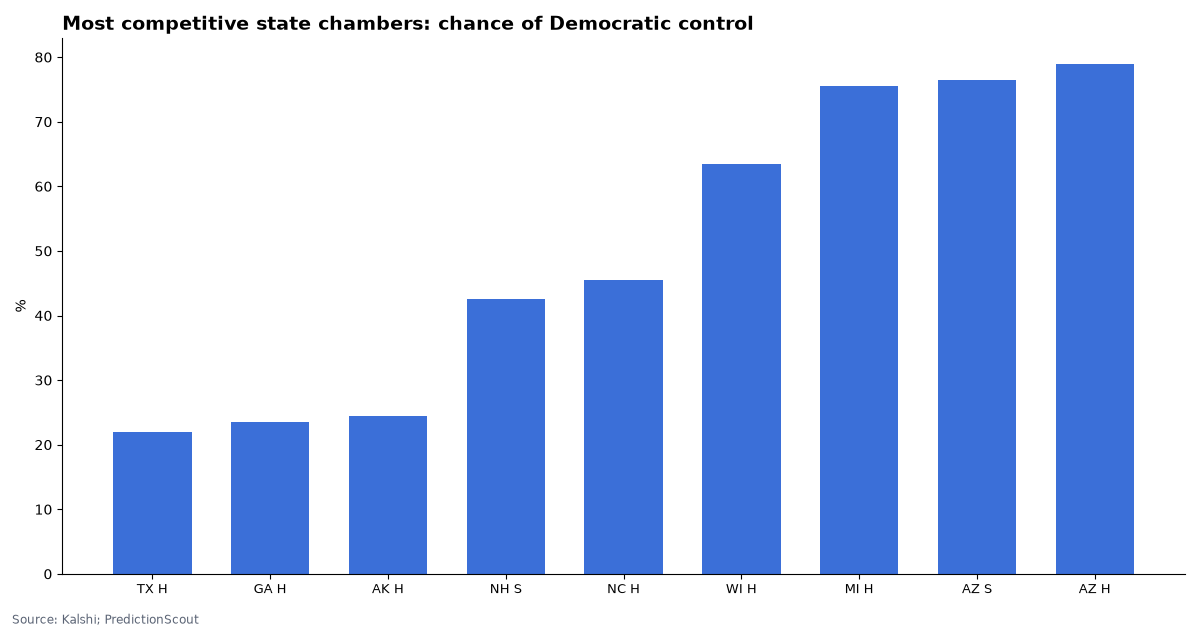
Kalshi lists control markets for 40 state legislative chambers in 2026 and 45 supermajority seat thresholds. Today the market favors a change of majority party in 6 of them, and 9 sit between 20% and 80%.
Control markets pay on which party holds more seats once the new legislature is seated, not on election night. This page shows today’s odds next to each chamber’s current membership and will score every market after the chambers organize.
Kalshi market data and Open States membership, pulled Oct 23, 2026, 10:17 AM ET. Updated daily.
By Arthur Angelo, PredictionScout Research · Updated Oct 23, 2026, 10:17 AM ET
Key findings
- 40 chambers, 45 supermajority thresholds. Control settles on seat counts two weeks after the chamber is seated, in early 2027.
- Busiest market: Iowa House, 43,815 contracts traded. Democratic control 11%, Republican 88%.
- Market favors a change in majority: Arizona Senate (now Republicans 13–17; Democrats 76%); Arizona House (now Republicans 27–33; Democrats 79%); New Hampshire House (now Republicans 169–211; Democrats 83%); Michigan House (now Republicans 52–58; Democrats 76%); Wisconsin Senate (now Republicans 15–18; Democrats 86%); Wisconsin Assembly (now Republicans 45–54; Democrats 64%).
- Closest: North Carolina House (Democratic 46%); New Hampshire Senate (Democratic 42%); Wisconsin Assembly (Democratic 64%); Michigan House (Democratic 76%); Alaska House (Democratic 24%); Arizona Senate (Democratic 76%).
How these markets work
Chamber control. Each contract asks whether one party “wins” a state House or Senate in 2026. Kalshi defines winning as holding more seats than any other party two weeks after the chamber is seated for the session following the election. A tie pays No for both parties. Formal coalitions and power-sharing agreements don’t matter, only the seat count. Kalshi may settle early once a consensus of media organizations projects the outcome.
Supermajorities. Each contract asks whether one party will hold at least a set number of seats after the November 3 general election, usually the two-thirds or three-fifths line needed to override a veto or pass constitutional amendments in that state.
Not every seat is up. Many state senates elect only half their members in 2026, so the seats not on the ballot are already known. A party can win the popular vote for the chamber and still lose control.
What moves the price. District-level polling, candidate filings and retirements, spending, redistricting, early-vote data and the national environment. Near the end, county and district returns move it. After Election Day, recounts, party switches and vacancies before the seating date can still matter.
Worked example: Michigan Senate
Open States lists the 38-seat Michigan Senate at 20 Democrats and 18 Republicans today. Kalshi prices Democratic control at 86% and Republican control at 13%. Because a tie pays No on both sides, the two prices can add up to less than 100%: at 19–19 both contracts would pay No. A party needs 20 of 38 seats to win. The market settles two weeks after the Senate is seated in January 2027, so a party switch or special election before then can change the result.
Chamber control, today
Chances are the bid/ask midpoint where there is a two-sided quote no wider than 10¢; a dash means no such quote. “Now” is the current membership in Open States (Democrats–Republicans). “Market favors a change” marks chambers where the party now in the minority is above 50%.
| Chamber | Now (D–R) | Seats | Democratic control | Republican control | Market favors a change | Volume |
|---|---|---|---|---|---|---|
| Iowa House | 33–66, 1 vacant | 100 | 11% | 88% | 43,815 | |
| Nevada Senate | 13–8 | 21 | 94% | 6% | 38,664 | |
| Minnesota House | 67–66, 1 vacant | 134 | 87% | 8% | 31,610 | |
| Texas Senate | 12–18, 1 vacant | 31 | 4% | 94% | 25,803 | |
| Michigan Senate | 20–18 | 38 | 86% | 13% | 24,950 | |
| Oregon House | 37–23 | 60 | 98% | 2% | 22,960 | |
| New Hampshire Senate | 8–16 | 24 | 42% | 38% | 22,667 | |
| Arizona Senate | 13–17 | 30 | 76% | 14% | Yes | 22,242 |
| Ohio Senate | 9–23, 1 vacant | 33 | 2% | 96% | 21,119 | |
| Maine Senate | 20–14 (1 other) | 35 | 94% | 6% | 20,663 | |
| Minnesota Senate | 34–33 | 67 | 87% | 10% | 20,565 | |
| Georgia House | 81–99 | 180 | 24% | 76% | 18,582 | |
| Texas House of Representatives | 62–86, 2 vacant | 150 | 22% | 76% | 17,107 | |
| Iowa Senate | 17–32, 1 vacant | 50 | 2% | 92% | 14,800 | |
| North Carolina House | 47–71 (2 other) | 120 | 46% | 50% | 13,013 | |
| Pennsylvania House | 103–100 | 203 | — | — | 12,077 | |
| Arizona House | 27–33 | 60 | 79% | 16% | Yes | 11,019 |
| New Hampshire House | 169–211 (2 other), 18 vacant | 400 | 83% | 16% | Yes | 9,527 |
| North Carolina Senate | 20–30 | 50 | 7% | — | 9,087 | |
| Michigan House | 52–58 | 110 | 76% | 20% | Yes | 8,825 |
| Ohio House | 34–65 | 99 | 6% | 92% | 8,662 | |
| Alaska Senate | 9–11 | 20 | 6% | 86% | 8,218 | |
| Vermont Senate | 17–13 | 30 | 96% | 4% | 6,869 | |
| Florida House of Representatives | 34–82, 4 vacant | 120 | 6% | 92% | 6,115 | |
| Florida Senate | 12–26 (1 other), 1 vacant | 40 | 4% | 98% | 5,065 | |
| Alaska House | 14–21 (5 other) | 40 | 24% | 74% | 5,063 | |
| Colorado House | 42–22, 1 vacant | 65 | 98% | 2% | 4,740 | |
| Wisconsin Senate | 15–18 | 33 | 86% | 12% | Yes | 4,345 |
| New York Senate | 40–22, 1 vacant | 63 | 98% | 2% | 3,928 | |
| Wisconsin Assembly | 45–54 | 99 | 64% | 36% | Yes | 3,297 |
| Nevada Assembly | 27–15 | 42 | 94% | 4% | 2,778 | |
| Georgia Senate | 22–33, 1 vacant | 56 | 12% | 88% | 608 | |
| New Mexico House | 42–26, 2 vacant | 70 | 98% | 2% | 564 | |
| Washington Senate | 30–19 | 49 | 98% | 2% | 483 | |
| Maine House | 75–73 (5 other), -2 vacant | 151 | 90% | 6% | 464 | |
| Washington House | 59–39 | 98 | 98% | 2% | 250 | |
| New York Assembly | 103–47 | 150 | 98% | 2% | 106 | |
| Oregon Senate | 18–12 | 30 | 98% | 2% | 47 | |
| Colorado Senate | 23–12 | 35 | 98% | 2% | 47 | |
| Vermont House | 90–57 (3 other) | 150 | 98% | 2% | 0 |
Supermajority seat thresholds
These ladders are thin. Few have a live two-sided quote, so the last traded price is shown where there was a trade. Treat a last trade on a few hundred dollars of volume as weak evidence.
| Chamber | Party | Seats needed | Held now | Chance (live quote) | Last trade | Volume |
|---|---|---|---|---|---|---|
| Utah Senate | Republican | 20 | 22 | — | 80% | 2,972 |
| Kansas House | Republican | 84 | 88 | — | 16% | 1,169 |
| Colorado House | Democratic | 44 | 42 | — | 54% | 211 |
| New Hampshire Senate | Republican | 16 | 16 | — | 12% | 100 |
| Arizona House | Republican | 40 | 33 | — | — | 0 |
| Arizona Senate | Republican | 20 | 17 | — | — | 0 |
| California Assembly | Democratic | 54 | 60 | — | — | 0 |
| California Senate | Democratic | 27 | 29 | — | — | 0 |
| Colorado Senate | Democratic | 24 | 23 | — | — | 0 |
| Connecticut House | Democratic | 101 | 102 | — | — | 0 |
| Connecticut Senate | Democratic | 24 | 25 | — | — | 0 |
| Delaware House | Democratic | 25 | 27 | — | — | 0 |
| Delaware Senate | Democratic | 13 | 15 | — | — | 0 |
| Florida House | Republican | 80 | 82 | — | — | 0 |
| Florida Senate | Republican | 27 | 26 | — | — | 0 |
| Georgia Senate | Republican | 38 | 33 | — | — | 0 |
| Hawaii Senate | Democratic | 17 | 22 | — | — | 0 |
| Idaho Senate | Republican | 24 | 29 | — | — | 0 |
| Illinois House | Democratic | 71 | 78 | — | — | 0 |
| Illinois Senate | Democratic | 36 | 40 | — | — | 0 |
| Iowa House | Republican | 67 | 66 | — | — | 0 |
| Iowa Senate | Republican | 34 | 32 | — | — | 0 |
| Maine Senate | Democratic | 24 | 20 | — | — | 0 |
| Maryland Senate | Democratic | 29 | 34 | — | — | 0 |
| Missouri House | Republican | 109 | 105 | — | — | 0 |
| Missouri Senate | Republican | 23 | 23 | — | — | 0 |
| Montana Senate | Republican | 34 | 32 | — | — | 0 |
| Nevada Assembly | Democratic | 28 | 27 | — | — | 0 |
| Nevada Senate | Democratic | 14 | 13 | — | — | 0 |
| New Mexico House | Democratic | 47 | 42 | — | — | 0 |
| New York Assembly | Democratic | 100 | 103 | — | — | 0 |
| New York Senate | Democratic | 42 | 40 | — | — | 0 |
| North Carolina House | Republican | 72 | 71 | — | — | 0 |
| North Carolina Senate | Republican | 30 | 30 | — | — | 0 |
| Ohio House | Republican | 60 | 65 | — | — | 0 |
| Ohio Senate | Republican | 20 | 23 | — | — | 0 |
| Oregon House | Democratic | 40 | 37 | — | — | 0 |
| Oregon Senate | Democratic | 20 | 18 | — | — | 0 |
| South Carolina House | Republican | 83 | 89 | — | — | 0 |
| Texas Senate | Republican | 21 | 18 | — | — | 0 |
| Vermont House | Democratic | 100 | 90 | — | — | 0 |
| Vermont Senate | Democratic | 20 | 17 | — | — | 0 |
| Washington House | Democratic | 66 | 59 | — | — | 0 |
| Washington Senate | Democratic | 33 | 30 | — | — | 0 |
| Wisconsin Senate | Republican | 22 | 18 | — | — | 0 |
Scoring after the chambers organize
We save every market daily and will store a final snapshot on the evening of November 3. After each chamber is seated, we will record which party holds more seats and score each market against it.
Download the data
Chamber control today (CSV)Supermajority thresholds (CSV)
Today’s control prices with current membership, and the supermajority thresholds. No price histories are included. Free to reuse under CC BY 4.0 with a link back to this page.
Embed this chart
Methodology
- Markets. Every open Kalshi
KXSTATELEG,KXPAHOUSE,KXDEMSTATESUPERMAJandKXGOPSTATESUPERMAJcontract, read from the public API with full paging. Pennsylvania has two duplicate House events; we keep the busier one. - Prices. Bid/ask midpoint, only where the two-sided spread is 10¢ or less.
- Current membership. Open States legislator records, counted by party and refreshed weekly (last pulled 2026-10-23). Seat totals are each chamber’s statutory size; the difference is shown as vacant.
- Scoring. Daily snapshots are stored; scoring begins once chambers organize.
- Limits. Nothing has settled yet; these are today’s odds, not a track record. Membership counts come from Open States and can lag party switches or resignations by a few days. Supermajority ladders are thin. Nothing here is investment advice. Last run: Oct 23, 2026, 10:17 AM ET.
Cite this research
Suggested citation: PredictionScout. (2026, October 23). State Legislature Prediction Markets for 2026: Chamber Control and Supermajorities. https://predictionscout.com/research/state-legislature-prediction-markets/
For a chart or news story: “Source: PredictionScout analysis of public exchange data (https://predictionscout.com/research/state-legislature-prediction-markets/)”
The data and charts on this page are free to reuse under CC BY 4.0 with a link back to this page. Market data: Kalshi. Legislator membership: Open States.
Data sources: prices and volumes come from the public APIs of Kalshi and Polymarket, with current membership from Open States. All trademarks belong to their owners. PredictionScout is independent and not affiliated with any exchange. Nothing here is investment, betting, or legal advice.
Related: state ballot measure markets · down-ballot statewide offices · All research