Kalshi lists 88 winner markets for statewide offices below governor and senator in 2026, from secretaries of state to the Texas Railroad Commission, plus 15 state supreme court contests and retention votes. Together they have traded about 2,130,473 contracts.
Like the top-of-ticket markets, they settle on certified results, so this page shows today’s odds and will score them after states certify. It also covers Georgia’s first-round markets, which pay on whether anyone clears 50% and avoids a runoff.
Kalshi market data and certified results, pulled Oct 23, 2026, 10:20 AM ET. Updated daily.
By Arthur Angelo, PredictionScout Research · Updated Oct 23, 2026, 10:20 AM ET
Key findings
- 88 statewide office races, 15 supreme court contests, 9 Georgia first-round markets. All settle on certified results.
- Busiest: New York Attorney General, 802,175 contracts traded. Letitia James 92%; Saritha Komatireddy 8%.
- Closest: 16 races where no outcome is above 65%: Georgia Secretary of State (Penny Brown Reynolds 52%); Arizona Superintendent of Public Instruction (Kimberly Yee 53%); Indiana Secretary of State (Beau Bayh 54%); Texas Railroad Commissioner (Jon Rosenthal 54%); Ohio Secretary of State (Robert Sprague 55%); Georgia Attorney General (Tanya Miller 56%).
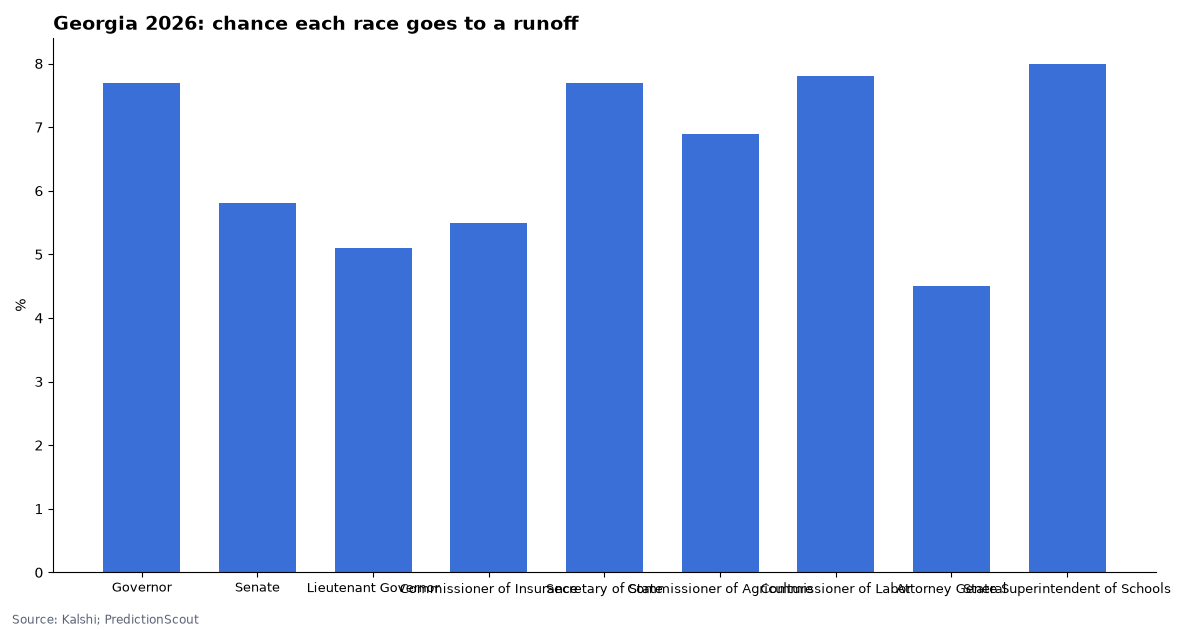
- Georgia runoffs: the market puts the highest runoff risk on State Superintendent of Schools, with a 8% chance nobody clears 50%. A 2022-style split, with the leader at 49.44%, would force a December 1 runoff.
How these markets work
Who wins. Most offices are a pair of party contracts (“Will the Democratic party win the Secretary of State election in Georgia?”) or one contract per candidate. A contract pays Yes if that party’s or candidate’s nominee is the certified winner. A few, like the Arizona Corporation Commission and the Michigan Supreme Court, pay on the party split across two seats.
Settlement. Kalshi uses the state’s certified result. Recounts and contests can push settlement into December or later, and in states that require a majority, a runoff decides the winner.
What moves the price. These races get little polling, so prices track the top of the ticket, the state’s partisan lean, incumbency, fundraising and, close to the end, early-vote data. A down-ballot race usually moves with the governor or Senate race on the same ballot, though ticket-splitting does happen.
Worked example: how a close down-ballot race settles
In 2022 Arizona’s attorney general race was decided by 280 votes out of about 2.5 million, after a mandatory statewide recount certified in late December 2022 (Arizona Secretary of State, 2022 recount canvass). Under these rules a “Democratic party wins” contract would have stayed open until that recount was certified and then paid Yes, even though media outlets did not call the race on election night. A race that close can stay open for weeks after Election Day.
Statewide office markets, today
Chances are bid/ask midpoints where there is a two-sided quote no wider than 10¢. “(no quote)” means the outcome has no such quote. Races are sorted by volume.
| Office | Chances (top outcomes) | Volume |
|---|---|---|
| New York Attorney General | Letitia James 92%; Saritha Komatireddy 8% | 802,175 |
| Texas Railroad Commissioner | Jon Rosenthal 54%; Bo French 46% | 165,856 |
| Minnesota Attorney General | Keith Ellison 76%; Ronald J. Schutz 20% | 150,637 |
| South Dakota Attorney General | Lance Russell 98%; Democratic party 2% | 77,728 |
| Delaware Attorney General | Kathy Jennings 97%; David C. Graham 2% | 55,004 |
| Arkansas Attorney General | Tim Griffin 98%; Democratic party 1% | 49,638 |
| Idaho Attorney General | Raúl Labrador 97%; Lori Hickman 3% | 46,046 |
| Arizona Attorney General | Kris Mayes 82%; Warren Petersen 16% | 45,845 |
| Texas Lieutenant Governor | Dan Patrick 68%; Vikki Goodwin 34% | 43,908 |
| Rhode Island Attorney General | Kim Ahern 97%; Alan Gordon 1% | 43,018 |
| Iowa Attorney General | Brenna Bird 57%; Nate Willems 44% | 42,124 |
| Colorado Attorney General | Jena Griswold 94%; Michael Allen 5% | 42,109 |
| North Dakota Attorney General | Drew Wrigley 97%; Tim Lamb 3% | 35,824 |
| Indiana Secretary of State | Beau Bayh 54%; Max Engling 46% | 34,759 |
| California Lieutenant Governor | Fiona Ma 96%; Gloria Romero 4% | 33,089 |
| Vermont Attorney General | Charity R. Clark 97%; Ed Kemon 2% | 29,808 |
| Florida Attorney General | James Uthmeier 80%; José Javier Rodriguez 20% | 28,537 |
| New Mexico Attorney General | Raúl Torrez 96%; Samuel Kane 4% | 25,044 |
| Wisconsin Attorney General | Josh Kaul 82%; Eric Toney 16% | 24,468 |
| Massachusetts Attorney General | Andrea Joy Campbell 98%; Michael C. Walsh 1% | 23,885 |
| Michigan Attorney General | Eli Savit 82%; Doug Lloyd 20% | 20,759 |
| Illinois Attorney General | Kwame Raoul 97%; Bob Fioretti 2% | 18,681 |
| Colorado Secretary of State | Amanda Gonzalez 96%; James Wiley 4%; Celeste Landry 2% | 18,442 |
| Vermont Lieutenant Governor | Molly Gray 92%; John S. Rodgers 6% | 17,824 |
| Michigan Secretary of State | Garlin Gilchrist 88%; Anthony Forlini 12% | 17,817 |
| Texas Attorney General | Mayes Middleton 72%; Nathan Johnson 26% | 16,783 |
| Minnesota Secretary of State | Steve Simon 88%; Tad Jude 10%; Seth Kuhl-Stennes 2% | 13,847 |
| Oklahoma Attorney General | Jon Echols 96%; Nick Coffey 5% | 13,598 |
| Connecticut Attorney General | William Tong 97%; John Bolton 2% | 13,105 |
| Georgia Attorney General | Tanya Miller 56%; Brian Strickland 43% | 12,658 |
| Alabama Attorney General | Katherine Robertson 96%; Jeffrey McLaughlin 4% | 12,607 |
| Kansas Attorney General | Chris Mann 56%; Kris Kobach 44% | 11,061 |
| California Attorney General | Rob Bonta 96%; Michael E. Gates 4% | 10,282 |
| Maryland Attorney General | Anthony G. Brown 98%; James B. Rutledge III 2% | 9,725 |
| Nevada Attorney General | Nicole Jeanette Cannizzaro 80%; Adriana Guzmán Fralick 18% | 9,051 |
| Texas Agriculture Commissioner | Nate Sheets 60%; Clayton Tucker 43% | 8,154 |
| Minnesota Auditor | Zack Filipovich 70%; Scott Jensen 31%; Jay Reeves 2% | 7,986 |
| Arizona Superintendent of Public Instruction | Kimberly Yee 53%; Teresa Leyba Ruiz 45%; Stephen Neal Jr. 2% | 7,927 |
| Iowa Secretary of State | Paul D. Pate 80%; Ryan Peterman 20% | 7,756 |
| Ohio Secretary of State | Robert Sprague 55%; Allison Russo 42% | 7,634 |
| Georgia Secretary of State | Penny Brown Reynolds 52%; Tim Fleming 45% | 7,436 |
| Arizona Secretary of State | Adrian Fontes 86%; Alexander Kolodin 15% | 6,354 |
| Nevada Lieutenant Governor | Sandra Jauregui 66%; Stavros Anthony 34%; Janine Hansen 2% | 6,280 |
| Wisconsin Treasurer | Yee Leng Xiong 79%; John S. Leiber 13% | 5,894 |
| Ohio Attorney General | Keith Faber 68%; John Kulewicz 30% | 5,838 |
| Nebraska Attorney General | Mike Hilgers 92%; Jocelyn Brasher 8% | 4,991 |
| Nevada Secretary of State | Cisco Aguilar 92%; Jim Marchant 8% | 4,507 |
| California Insurance Commissioner | Ben Allen 73%; Jane Kim 27% | 4,408 |
| Georgia Lieutenant Governor | Josh McLaurin 56%; Greg Dolezal 45% | 4,392 |
| Wisconsin Secretary of State | JoCasta Zamarripa 81%; Jay Schroeder 18% | 3,839 |
| Iowa Secretary of Agriculture | Mike Naig 57%; Chris Jones 44% | 3,726 |
| Rhode Island Lieutenant Governor | Sabina Matos 64%; John Loughlin 36% | 2,783 |
| South Carolina Attorney General | David Stumbo 93%; Richard Hricik 6% | 1,941 |
| California Superintendent of Public Instruction | Richard Barrera 75%; Sonja Shaw 26% | 1,683 |
| Massachusetts Secretary of State | William Francis Galvin 94%; Anne R. Brensley 4% | 1,618 |
| Ohio Auditor | Frank LaRose 65%; Annette Blackwell 34% | 1,372 |
| Nevada Controller | Andy Matthews 67%; Michael MacDougall 33% | 1,169 |
| Iowa Auditor | Chris Cournoyer 64%; Taylor Wettach 36% | 916 |
| Georgia Agriculture Commissioner | Tyler Harper 76%; Katherine E. Juhan-Arnold 22% | 790 |
| South Dakota Secretary of State | Heather Baxter 90%; Terrence Davis 6%; Tamara J. Lesnar 2% | 681 |
| California Secretary of State | Shirley N. Weber 96%; Donald P. (Don) Wagner 4% | 623 |
| Nevada Treasurer | Tya Mathis-Coleman 58%; Drew Johnson 42% | 475 |
| Nebraska Secretary of State | Scott Petersen 90%; Paul Rumbaugh 4%; Bob Krist 3% | 403 |
| New Mexico Secretary of State | Amanda López Askin 94%; Ramona L. Goolsby 4% | 355 |
| Wyoming Secretary of State | Robert Short 90%; Bryan McCarty 4%; Tamara Trujillo 3% | 355 |
| Idaho Secretary of State | Phil McGrane 92%; Shawn Keenan 7% | 350 |
| Ohio Treasurer | Jay Edwards 70%; Seth Walsh 32% | 255 |
| Oklahoma Lieutenant Governor | T.W. Shannon 92%; Kelly Forbes 8% | 247 |
| Georgia Insurance Commissioner | John King 75%; Keisha Sean Waites 26% | 227 |
| Arizona Treasurer | Elijah Norton 58%; Nick Mansour 42% | 212 |
| North Dakota Secretary of State | Michael Howe 98%; Ryan Braunberger 2% | 206 |
| Texas Comptroller | Don Huffines 80%; Sarah Eckhardt 22% | 186 |
| Illinois Secretary of State | Alexi Giannoulias 94%; Diane M. Harris 4% | 159 |
| Connecticut Secretary of State | Stephanie Thomas 93%; Peter Lumaj 6% | 156 |
| Vermont Secretary of State | Sarah Copeland Hanzas 92%; Rachel Shaw 5%; H. Brooke Paige 2% | 100 |
| Texas Land Commissioner | Dawn Buckingham 82%; Benjamin Flores 19% | 84 |
| Kansas Secretary of State | Pat Proctor 88%; Jennifer Day 5%; Scott Morgan 4% | 78 |
| Arizona Corporation Commission (2 seats) | 2 Republicans 89%; 1 Republican + 1 Democrat 10%; 2 Democrats 3% | 65 |
| Alabama Secretary of State | Caroleene Dobson 92%; Wayne Rogers 5% | 55 |
| Arkansas Secretary of State | Kim Hammer 92%; Michael Pakko 2%; Kelly Grappe 2% | 47 |
| Arizona Mine Inspector | Walter "Les" Presmyk 67%; Brian Matlock 33% | 14 |
| South Carolina Secretary of State | Mark Hammond 88%; Jason Belton 8% | 0 |
| Alabama Lieutenant Governor | John Wahl 96%; Phillip Ensler 3% | 0 |
| Arkansas Lieutenant Governor | Leslie Rutledge 96%; Michael Kalagias 3% | 0 |
| Idaho Lieutenant Governor | Scott Bedke 96%; Eric Myricks 3% | 0 |
| Georgia Labor Commissioner | Bárbara Rivera Holmes 60%; Nikki Porcher 0% | 0 |
| Georgia School Superintendent | Richard Woods 70%; Lydia Powell 30% | 0 |
| Iowa Treasurer | Roby Smith 80%; John Norwood 20% | 0 |
State supreme court races and retention votes
Many states fill supreme court seats by election. Contested elections (North Carolina, Texas, Ohio, Alabama, Michigan, Montana, Washington) work like any other race: the certified winner’s contract pays Yes. Some are partisan; Michigan, Montana and Washington are formally nonpartisan, so the contracts name candidates, and Michigan’s parties nominate candidates who appear without a label. Retention elections (Kansas, Missouri, Wyoming) ask voters only whether a sitting justice should stay. The contract pays Yes if the justice gets the share of yes votes state law requires, a simple majority in all three. Justices rarely lose retention votes, so these markets usually price retention high, and they trade thinly.
What moves the price. Court races get almost no public polling. Prices follow the partisan lean of the state, spending by outside groups, endorsements and, in retention votes, organized campaigns against a justice.
Worked example. If Kansas Justice Eric Rosen receives more yes than no votes in the certified canvass, the retention contract pays Yes. A 49.9% yes share pays No, and he would leave the bench at the end of his term.
| Court race | Chances (top outcomes) | Volume |
|---|---|---|
| Ohio Supreme Court (Hawkins seat) | Dan Hawkins 76%; Marilyn Zayas 24% | 2,622 |
| North Carolina Supreme Court seat | Anita Earls 88%; Sarah Stevens 12% | 1,776 |
| Texas Supreme Court Chief Justice | Jimmy Blacklock 74%; Maggie Ellis 26% | 1,031 |
| Texas Supreme Court Place 8 | Brett Busby 67%; Gisela D. Triana 29% | 721 |
| Texas Supreme Court Place 7 | Kyle Hawkins 79%; Kristen Hawkins 21% | 388 |
| Wyoming Supreme Court retention (Jarosh) | Yes 88% | 360 |
| Montana Supreme Court seat | Amy Eddy 56%; Dan Wilson 45% | 202 |
| Ohio Supreme Court (Brunner seat) | Colleen O’Donnell 60%; Jennifer Brunner 45% | 137 |
| Missouri Supreme Court retention (Wilson) | Yes 86% | 55 |
| Kansas Supreme Court retention (Rosen) | Yes 80% | 23 |
| Michigan Supreme Court (2 seats) | Democrat sweep 86%; 1 Democrat and 1 Republican 5%; Republican sweep 4% | 14 |
| Washington Supreme Court Position 3 | David Stevens 80%; Jaime Hawk 20% | 6 |
| Washington Supreme Court Position 5 | Theo Angelis 80%; Dave Larson 20% | 1 |
| Texas Supreme Court Place 2 | James P. Sullivan 90%; Chari Kelly 10% | 0 |
| Alabama Supreme Court Place 8 | Greg Shaw 90%; AshLeigh Dunham 10% | 0 |
Georgia’s first round: will anyone clear 50%?
Georgia requires a majority to win a general election (O.C.G.A. § 21-2-501). If no candidate gets more than 50% of the votes cast, the top two meet in a runoff four weeks later, on December 1, 2026. Kalshi’s KXGA1ROUND markets pay Yes if any candidate clears that threshold in the first round. They pay on the arithmetic, not on which party wins, and a third-party candidate taking 2–3% is often enough to force a runoff in a close race.
Worked example: 2022 Senate. The Clerk of the House reports the November 8, 2022 general election as Raphael Warnock 1,946,117, Herschel Walker 1,908,442 and Chase Oliver (Libertarian) 81,365, out of 3,935,924 votes. Warnock led with 49.44%, short of a majority, so a “will anyone win in the first round” contract would have paid No. In the December 6 runoff Warnock won 1,820,633 to 1,721,244.
Chance of a first-round winner, today, by office (the runoff chance is the remainder):
| Office | Someone clears 50% | Runoff | Volume |
|---|---|---|---|
| Governor | 92% | 8% | 16,398 |
| Senate | 94% | 6% | 8,849 |
| Lieutenant Governor | 95% | 5% | 8,384 |
| Commissioner of Insurance | 94% | 6% | 7,617 |
| Secretary of State | 92% | 8% | 1,272 |
| Commissioner of Agriculture | 93% | 7% | 871 |
| Commissioner of Labor | 92% | 8% | 617 |
| Attorney General | 96% | 5% | 567 |
| State Superintendent of Schools | 92% | 8% | 392 |
Scoring after certification
We save every market daily and will store a final snapshot on the evening of November 3. Once states certify, and after any Georgia runoffs on December 1, each market will be scored against the certified winner.
Download the data
Statewide office markets today (CSV)State supreme court markets today (CSV)Georgia first-round markets today (CSV)
Today’s prices for every outcome, one row per outcome. No price histories are included. Free to reuse under CC BY 4.0 with a link back to this page.
Embed this chart
Methodology
- Markets. Every open Kalshi series for 2026 secretary of state, attorney general, lieutenant governor and other statewide row offices, state supreme courts and
KXGA1ROUND, read from the public API with full paging. Combination markets (such as Texas Railroad Commissioner and Senate together) are left out. - Prices. Bid/ask midpoint, only where the two-sided spread is 10¢ or less.
- Certified results. Georgia 2022 counts from the Clerk of the House’s “Statistics of the Congressional Election of November 8, 2022”; the Arizona 2022 example from the Arizona Secretary of State’s recount canvass.
- Scoring. Daily snapshots are stored; scoring begins once each state certifies.
- Limits. Nothing has settled yet; these are today’s odds, not a track record. Many down-ballot and court markets trade thinly, and outcomes without a live quote are shown without a price. Nothing here is investment advice. Last run: Oct 23, 2026, 10:20 AM ET.
Cite this research
Suggested citation: PredictionScout. (2026, October 23). Down-Ballot Statewide Office and State Supreme Court Prediction Markets for 2026. https://predictionscout.com/research/down-ballot-statewide-office-prediction-markets/
For a chart or news story: “Source: PredictionScout analysis of public exchange data (https://predictionscout.com/research/down-ballot-statewide-office-prediction-markets/)”
The data and charts on this page are free to reuse under CC BY 4.0 with a link back to this page. Market data: Kalshi. Certified results: Clerk of the U.S. House; Arizona Secretary of State.
Data sources: prices and volumes come from the public APIs of Kalshi and Polymarket, with certified results from the Clerk of the House. All trademarks belong to their owners. PredictionScout is independent and not affiliated with any exchange. Nothing here is investment, betting, or legal advice.
Related: state legislature markets · vote-share and margin markets · All research