$140,546 a day
in market-maker rewards across 6,565 active Kalshi incentive programs on Nov 12, 2026, versus $126,943 a day across 11,269 reward-paying Polymarket markets.
Kalshi and Polymarket public APIs, Nov 12, 2026, pulled Nov 12, 2026, 8:02 AM ET. Updated daily.
By Arthur Angelo, PredictionScout Research · Updated Nov 12, 2026, 8:02 AM ET
Key findings
- Kalshi has 6,565 active incentive programs with $664,210 in total period rewards; 5,484 cover whole series and 1,006 seed newly listed events.
- The median Kalshi program pays $100 over its period; the largest pays $1,000 on KXONIONACT-30JAN01-27JAN01.
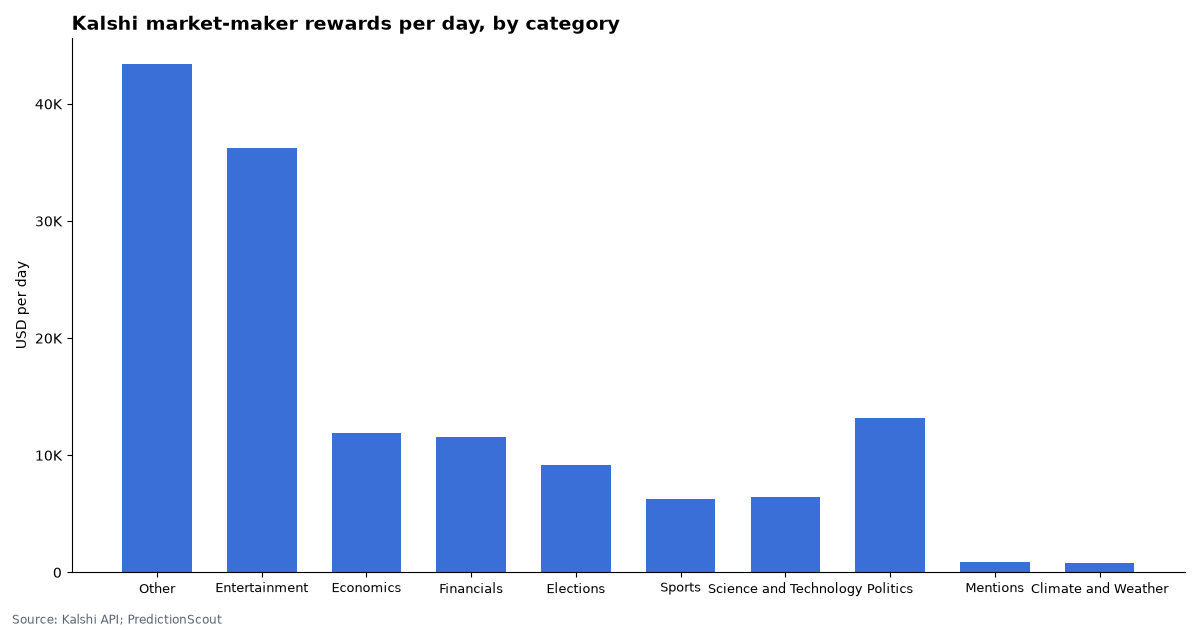
- Other accounts for the most Kalshi reward money ($171,555 in period rewards).
- Polymarket pays $126,943 a day across 11,269 reward-eligible markets; the top market pays $10,000 a day.
- The latest scheduled Kalshi program ends Nov 27, 2026.
How market-maker incentives work
Both exchanges pay traders who keep resting orders on the book, because tight, deep quotes make markets cheaper for everyone else. Kalshi’s liquidity incentive program sets a reward pool for a market over a period. During the period Kalshi samples the order book; resting orders near the best price that meet the target size earn a share of the pool, and orders further from the best price count for less (the discount factor sets how fast credit falls away). Volume programs instead pay on traded contracts. Polymarket’s liquidity rewards set a daily rate per market. Orders must be at least the minimum size and within the maximum spread of the midpoint; closer and two-sided quotes score higher, and the daily pool is split by score.
What moves the reward pools
- New and big events. Kalshi runs “new event” programs to seed fresh markets, and larger pools on headline events.
- Series programs. Most Kalshi programs are series-wide, covering every strike of a recurring market such as a weekly economic number.
- Competition. A pool is fixed, so more market makers quoting means a smaller share each.
- Schedule. Programs start and end on set dates, so totals jump when a batch begins or ends.
Worked example
A Kalshi program pays $300 over 7 days on one market, with a target size of 1,000 contracts and a 50% discount factor. A market maker who keeps 1,000 contracts resting at the best bid about half the time, with similar competition, might score a quarter of the pool: about $75 for the week, roughly $10.70 a day. A quote one tick behind the best price earns credit at the discounted rate, so it earns less. On Polymarket, a market paying $50 a day with a 200-share minimum and a 3.5¢ maximum spread pays nothing for an order 4¢ from the midpoint, however large.
Kalshi programs by category
| Category | Programs | Period rewards | Per day |
|---|---|---|---|
| Other | 1,312 | $171,555 | $43,454 |
| Entertainment | 1,558 | $147,455 | $36,213 |
| Economics | 628 | $81,870 | $11,873 |
| Financials | 720 | $72,750 | $11,526 |
| Elections | 1,073 | $62,235 | $9,129 |
| Sports | 407 | $41,410 | $6,236 |
| Science and Technology | 365 | $34,800 | $6,457 |
| Politics | 318 | $34,330 | $13,181 |
| Mentions | 102 | $7,275 | $898 |
| Climate and Weather | 25 | $5,330 | $837 |
| Companies | 57 | $5,200 | $743 |
Largest active Kalshi programs
Target size is in contracts; the discount factor is the share of credit kept for each step back from the best price.
| Market ticker | Type | Period | Reward | Target size | Discount factor |
|---|---|---|---|---|---|
| KXONIONACT-30JAN01-27JAN01 | liquidity | Nov 7–Nov 14 | $1,000 | 1,000 | 50% |
| KXONIONACT-30JAN01-28JAN01 | liquidity | Nov 7–Nov 14 | $1,000 | 1,000 | 50% |
| KXONIONACT-30JAN01-30JAN01 | liquidity | Nov 7–Nov 14 | $1,000 | 1,000 | 50% |
| KXONIONACT-30JAN01-29JAN01 | liquidity | Nov 7–Nov 14 | $1,000 | 1,000 | 50% |
| KXTXINCOMETAX-30JAN01-28JAN01 | liquidity | Nov 12–Nov 19 | $500 | 1,000 | 50% |
| KXTXINCOMETAX-30JAN01-30JAN01 | liquidity | Nov 12–Nov 19 | $500 | 1,000 | 50% |
| KXTXINCOMETAX-30JAN01-29JAN01 | liquidity | Nov 12–Nov 19 | $500 | 1,000 | 50% |
| KXASPENMTNOPEN-27-15NOV26 | liquidity | Nov 11–Nov 18 | $425 | 1,000 | 50% |
| KXBIGSKYOPEN-27-15NOV26 | liquidity | Nov 11–Nov 18 | $425 | 1,000 | 50% |
| KXBIGSKYOPEN-27-06DEC26 | liquidity | Nov 11–Nov 18 | $400 | 1,000 | 50% |
| KXBIGSKYOPEN-27-22NOV26 | liquidity | Nov 11–Nov 18 | $400 | 1,000 | 50% |
| KXASPENMTNOPEN-27-06DEC26 | liquidity | Nov 11–Nov 18 | $400 | 1,000 | 50% |
Largest Polymarket daily rewards
| Market | Per day | Min size (shares) | Max spread |
|---|---|---|---|
| Jensen Huang announced resignation or removal by November 12, 2026? | $10,000 | 50 | 5.5¢ |
| Jensen Huang announced resignation or removal by December 31, 2026? | $4,000 | 200 | 3.5¢ |
| Jensen Huang announced resignation or removal by November 13, 2026? | $2,000 | 50 | 5.5¢ |
| Will the Fed increase interest rates by 25 bps after the December 2026 meeting? | $1,000 | 200 | 3.5¢ |
| Jensen Huang announced resignation or removal by November 30, 2026? | $1,000 | 50 | 5.5¢ |
| Will the Fed increase interest rates by 50+ bps after the December 2026 meeting? | $600 | 200 | 2.5¢ |
| Will Gadi Eizenkot be the next Prime Minister of Israel? | $555 | 200 | 5.5¢ |
| Will Nvidia’s market capitalization be less than $4.00T at the end of 2026? | $524 | 200 | 4.5¢ |
| Will Jon Ossoff win the 2028 Democratic presidential nomination? | $510 | 200 | 5.5¢ |
| US announces end of Iranian blockade by December 31, 2026? | $500 | 200 | 5.5¢ |
| US announces end of Iranian blockade by November 30, 2026? | $500 | 200 | 5.5¢ |
| Commanders vs. Giants | $500 | 1,000 | 2.5¢ |
Rewards lower the effective cost of quoting; for the costs takers pay, see the trading-costs page. For which side takers choose, see Kalshi taker flow.
Download the data
Every active Kalshi program and every reward-paying Polymarket market (CSV)
One row per Kalshi program and per Polymarket reward market. Free to reuse under CC BY 4.0 with a link back to this page.
Embed this chart
Methodology
- Kalshi. Public /incentive_programs endpoint, status active. period_reward is in centi-cents (divided by 10,000 for dollars), per Kalshi’s API specification. Per day = reward ÷ program length.
- Polymarket. Public CLOB /sampling-markets list (every market currently eligible for liquidity rewards); rewards_daily_rate summed per market, with min_size and max_spread. Rates are in the reward token’s units, treated as dollars.
- Categories. Kalshi’s own series category.
- Limits. Pools are what is offered, not what any one trader earns. Polymarket holding rewards are excluded because the rate is not published per market. Kalshi per-day figures spread each program’s reward evenly over its period. Nothing here is investment advice. Last run: Nov 12, 2026, 8:02 AM ET.
Cite this research
Suggested citation: PredictionScout. (2026, November 12). Prediction Market Maker Incentives: Kalshi vs Polymarket Rewards. https://predictionscout.com/research/prediction-market-maker-incentives/
For a chart or news story: “Source: PredictionScout analysis of public exchange data (https://predictionscout.com/research/prediction-market-maker-incentives/)”
The data and charts on this page are free to reuse under CC BY 4.0 with a link back to this page. Data: Kalshi and Polymarket public APIs.
Data sources: prices and volumes come from the public APIs of Kalshi and Polymarket. All trademarks belong to their owners. PredictionScout is independent and not affiliated with any exchange. Nothing here is investment, betting, or legal advice.
Related: Trading costs · Kalshi taker flow · All research