5 markets
Kalshi lists 2026 building-permit markets for 5 places. Census data through September 2026 show where each stands; the table projects each full year by applying this year’s pace to the 2025 total.
Kalshi market data and U.S. Census Bureau Building Permits Survey, pulled Nov 12, 2026, 8:04 AM ET. Updated daily.
By Arthur Angelo, PredictionScout Research · Updated Nov 12, 2026, 8:04 AM ET
Key findings
- Colorado: 23,744 units through September 2026 (-1.6% vs 2025).
- California: 83,850 units through September 2026 (+8.8% vs 2025).
- Vermont: 1,210 units through September 2026 (-39.8% vs 2025).
- Connecticut (5+ unit buildings): 2,213 units through September 2026 (-33.8% vs 2025).
- Bozeman, MT metro (Gallatin County): 1,197 units through September 2026 (+7.0% vs 2025).
The markets
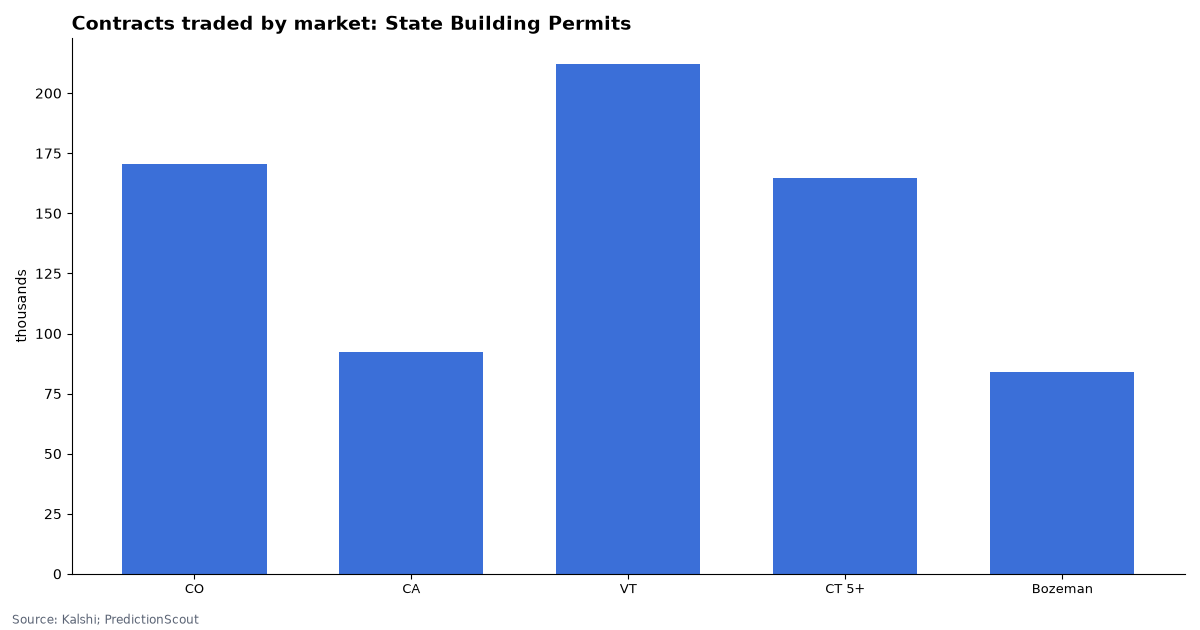
| Market | Closes | Market middle | Contracts (chance) | Census year-to-date | Contracts traded |
|---|---|---|---|---|---|
| Colorado: 2026 permitted units | 2027-01-27 | 30,951 | >30,000: 70% · >32,000: 29% · >34,000: 10% · >36,000: 6% · >38,000: 2% | 23,744 units Jan–Sep 2026; on pace for about 33,098 | 170,588 |
| California: 2026 permitted units | 2027-01-27 | 110,743 | >100,000: 96% · >105,000: 90% · >110,000: 56% · >115,000: 18% · >120,000: 6% | 83,850 units Jan–Sep 2026; on pace for about 113,792 | 92,371 |
| Vermont: 2026 permitted units | 2027-05-03 | 1,677 | >1,500: 95% · >1,600: 68% · >1,700: 44% · >1,800: 24% · >1,900: 17% | 1,210 units Jan–Sep 2026; on pace for about 1,477 | 212,278 |
| Connecticut (5+ unit buildings): 2026 permitted units | 2027-05-03 | 3,197 | >2,000: 96% · >2,500: 90% · >3,000: 72% · >3,500: 17% · >4,000: 16% | 2,213 units Jan–Sep 2026; on pace for about 3,052 | 164,748 |
| Bozeman, MT metro (Gallatin County): 2026 permitted units | 2027-05-31 | above 1,550 | >1,100: 96% · >1,250: 92% · >1,400: 88% · >1,550: 56% · >1,700: 50% | 1,197 units Jan–Sep 2026; on pace for about 1,577 | 84,239 |
Market middle: for “above X” ladders, the point where the implied chance crosses 50% (prices forced to fall as the threshold rises, interpolated between rungs). Prices are the bid/ask midpoint when the spread is 10¢ or less, otherwise the last trade. Events with fewer than 500 contracts traded show “thin trading” instead of a middle, and ladders whose quoted prices contradict each other show “prices out of order”. Pulled Nov 12, 2026, 8:04 AM ET.
Census year-to-date counts
Housing units authorized by building permits, January through September, including the Census Bureau’s estimates for places that did not report.
| Place | 2026 Jan–Sep | 2025 Jan–Sep | Change | 2025 full year | 2026 at this pace |
|---|---|---|---|---|---|
| Colorado | 23,744 | 24,121 | -1.6% | 33,624 | 33,098 |
| California | 83,850 | 77,096 | +8.8% | 104,626 | 113,792 |
| Vermont | 1,210 | 2,011 | -39.8% | 2,455 | 1,477 |
| Connecticut (5+ unit buildings) | 2,213 | 3,344 | -33.8% | 4,612 | 3,052 |
| Bozeman, MT metro (Gallatin County) | 1,197 | 1,119 | +7.0% | 1,474 | 1,577 |
How they settle
Each market settles on the Census Bureau’s annual Building Permits Survey total for calendar 2026: new privately owned housing units authorized by permits. Colorado, California, Vermont and Bozeman count all units; the Connecticut market counts only units in buildings with five or more units. The Bozeman, MT metro area is Gallatin County. The annual figures come out in the spring after the year ends and include imputed numbers for places that did not report, so they can differ a little from the sum of the monthly releases.
What moves it
Mortgage rates and builder confidence drive single-family permits. Apartment permits are lumpy: one 300-unit project can swing a small state’s total, which matters most for Vermont, Connecticut’s 5+ unit count and Bozeman. Local zoning changes and the timing of large projects also matter. Permits in the fall tend to run below the spring peak, so a simple year-to-date pace can overstate the final number slightly.
Worked example
Colorado has 23,744 units permitted through September, -1.6% against the same months of 2025. Applying that change to the 2025 total of 33,624 gives about 33,098 for 2026. If the market’s middle sits above that, traders are expecting the last 3 months to run faster than the year so far.
Download the data
State Building Permits markets (one row per event) (CSV)
One row per live event: market middle, contracts listed and traded, and the latest official value. No contract prices or price histories. Free to reuse under CC BY 4.0 with a link back to this page.
Embed this chart
Methodology
- Markets. Open Kalshi events for each series, read from the public API. Prices are bid/ask midpoints when the spread is 10¢ or less, otherwise the last trade.
- Official values. Census Bureau Building Permits Survey year-to-date state and county files (st/co 2609y.txt, with 2025 comparisons), pulled on the run date.
- No prices in the CSV. One row per event: market middle, contracts listed and traded, and the latest official value.
- Limits. Market middles are snapshots, not forecasts we endorse. Official values shown are the latest published, not necessarily the period each market settles on. Thinly traded events are flagged. Nothing here is investment advice. Last run: Nov 12, 2026, 8:04 AM ET.
Cite this research
Suggested citation: PredictionScout. (2026, November 12). State Building Permit Prediction Markets vs Census Data. https://predictionscout.com/research/state-building-permits-prediction-markets/
For a chart or news story: “Source: PredictionScout analysis of public exchange data (https://predictionscout.com/research/state-building-permits-prediction-markets/)”
The data and charts on this page are free to reuse under CC BY 4.0 with a link back to this page. Market data: Kalshi. Official data: U.S. Census Bureau Building Permits Survey.
Data sources: prices and volumes come from the public APIs of Kalshi and Polymarket. All trademarks belong to their owners. PredictionScout is independent and not affiliated with any exchange. Nothing here is investment, betting, or legal advice.
Related: National building permits markets · Housing starts markets · All research